
Have you ever traveled to a destination eager to tour its attractions only to find that the weather was not what you expected? If you have, then you understand the frustration that can come with these surprises, as you often have to adjust your itinerary, which can mean missing out on the spots you wanted to see. But luckily for you, Central Otago and the Southern Lakes have such predictable weather that you can plan your trip knowing what to expect each season.
Let’s get into the variations in each region and how to navigate them.
Central Otago
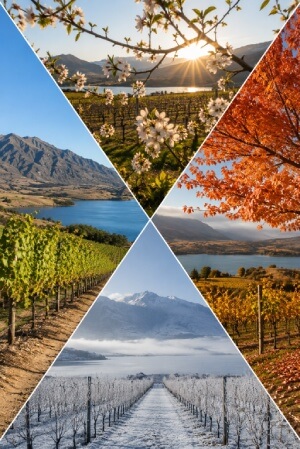
Given that this is a semi-arid region, you can expect seasonal shifts that will affect the feasibility of your travel plans. How so?
Spring
This season, which boasts cool weather, lasts from September to November and is considered a shoulder season, making it ideal for tourists who want to avoid crowds. Even so, the weather can be a tad unpredictable, such that a storm can follow a sunny morning. But for the most part, the weather is ideal for outdoor activities such as wine-tasting, cycling, hiking, and sightseeing. And if it happens to storm, you can always relax in the cafes or tour a museum.
Summer
Between December and February, Central Otago hits its peak tourist season as its weather changes to hot and dry, with temperatures averaging 30°C to 35°C (86°F to 95°F). As you would expect, the tourist numbers increase, as do the number of activities. From swimming to water sports, orchard visits, and vineyard dining, there is a long list of activities available. Since it can get too hot, be sure to plan outdoor activities in the early morning or late evening.
Autumn
The landscape dramatically changes to give way to deep reds, oranges, and golds that make this season quite perfect for tourists who are all about the visuals. And with the temperatures falling, you can enjoy long bike rides, walks, hikes, and more in the trails and hills. Grape harvesting also happens at this time, as do the harvest festival events.
Winter
While temperatures fall to -5°C to 5°C (23°F to 41°F), Central Otago rarely has snow in its valleys, but it does get hoarfrost, which is essentially a layer of ice crystals coupled with thick fog. Many people avoid the region at this time due to the biting cold and dark ambiance that makes it hard to engage in outdoor activities. Moreover, most cafes and stalls shut down. Even so, there are things to do, such as touring the towns, taking scenic photographs, or touring the nearby alpine zones where you can ski or snowboard.
Southern Lakes
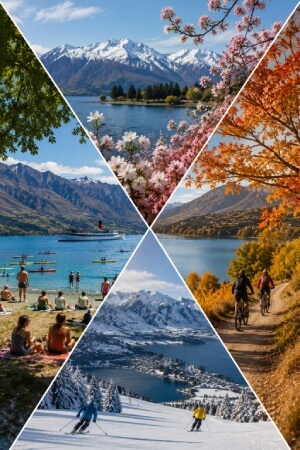
Queenstown, Wānaka, and Arrowtown are arguably some of the most popular destinations in the Southern Lakes. And this has a lot to do with the weather. You see, unlike Central Otago, which only has one peak all year, the Southern Lakes peak in both winter and summer. Let’s see how this plays out:
Spring
From September to November, the weather warms up to a comfortable 15°C to 20°C (59°F to 68°F), and the region comes alive with beautiful flowers and lambs dotting the now green valleys. And with the mountains still capped in snow, the view is just surreal. As a shoulder season, spring appeals to tourists who want to avoid the crowds in the peak seasons. They get to engage in activities such as skiing, sightseeing, cruises, touring the towns, biking, and hiking.
It is helpful to note that this season is quite unpredictable, such that high winds and heavy rains can occur suddenly. But with local spas and restaurants open, there is always something to do.
Summer
Just like Central Otago, summer is a peak season that lasts from December to February. The temperatures are not as high, though, as they average 22°C to 30°C (72°F to 86°F). Tourists come in by the throngs to enjoy the vibrant lake life where they can swim, kayak, paddleboard, ride jet skis, and take cruises. They also enjoy multi-day mountain hikes as well as adrenaline sports such as paragliding, mountain biking, and bungee jumping. Even with all the bustle of tourists, you can still enjoy a quiet holiday by moving towards the quieter parts of the lakes.
Autumn
With the summer winds and most tourists gone, visitors get to enjoy a quiet ambiance accompanied by cool temperatures averaging 10°C to 20°C (50°F to 68°F). And with the landscape turning gold and red, it is quite a spectacular sight. Just like with spring, most visitors gravitate towards outdoor activities such as walking, cycling, and wine tourism. It is also a great time to participate in the local festivals.
Winter
As the skies get grey and snow rests on the mountains between June and August, the temperatures dip to 0°C to 8°C (32°F to 46°F). And once again, it is peak season for tourists who love snow and cozy alpine experiences. You get to enjoy snow sports like skiing, a thriving nightlife complete with outdoor fire pits, and tons of winter wellness experiences. Scenic flights and winter lake cruises are also an option.